
A Revit matchline is an annotation line used to show where a large view is split across two or more dependent views. Add a view reference beside the matchline to point readers to the matching view, detail number, and sheet number.
Use matchlines when a floor plan, structural plan, MEP plan, elevation, or section is too large to fit clearly on one sheet at the required scale. The clean workflow is: create dependent views, crop each dependent view, draw the matchline in the primary view, place each view on a sheet, then add view references on the correct side of the matchline.
In This Guide
- What a Revit Matchline Does
- Matchline vs View Reference
- Create Dependent Views
- Add a Matchline in Revit
- Add View References
- Edit Matchline Visibility and Style
- Fix Common Matchline Problems
What Is a Matchline in Revit?
A matchline in Revit is a sketch-based annotation that marks the boundary between related views. It does not cut model geometry. Instead, it tells the reader that the drawing continues in another view or on another sheet.
The most common use is a large building plan. If the plan cannot fit on one sheet at 1/8″ = 1′-0″, 1:100, or your office standard scale, you can split it into Area A and Area B. Each area becomes a dependent view with its own crop region. The matchline shows the split, and the view reference tells the reader where the other half is located.

Matchline vs View Reference
A matchline and a view reference work together, but they are not the same thing.
| Item | Purpose | Where to find it |
|---|---|---|
| Matchline | Draws the visual split line between related views. | View tab > Sheet Composition > Matchline |
| View Reference | Displays the linked view’s detail number and sheet number. | Annotate tab > Tag > View Reference |
| Dependent View | Keeps split views coordinated with the primary view. | Project Browser > Duplicate View > Duplicate as Dependent |
Autodesk’s current Revit 2026 documentation describes view references as symbols that show the corresponding view’s detail number and sheet number when the referenced view is placed on a sheet. They can be placed in standard project views, except perspective views, schedules, and sheet views. If you are working in a sheet, right-click the viewport and choose Activate View before placing the reference.
Create Dependent Views First
For large plans, the strongest matchline setup starts with dependent views. A dependent view stays linked to the primary view, so view-specific changes such as annotations and view scale can stay coordinated across the split set. This is usually better than making several independent duplicate views for the same drawing area.
- In the Project Browser, right-click the plan, elevation, section, or other view you want to split.
- Choose Duplicate View > Duplicate as Dependent.
- Repeat until you have the number of drawing areas you need.
- Rename the dependent views clearly, such as Level 1 – Area A and Level 1 – Area B.
- Open each dependent view and turn on the crop region if it is hidden.
- Adjust each crop region so the views overlap slightly at the matchline.

Learn more about duplicating Revit views
How to Add a Matchline in Revit
Add the matchline from the primary view, not randomly from one sheet. This keeps the matchline visible and coordinated across the primary and related dependent views.
- Open the primary view that owns the dependent views.
- If crop regions are hidden, click Show Crop Region on the View Control Bar.
- Go to View tab > Sheet Composition panel > Matchline.
- Use the Draw tools to sketch the matchline at the split location.
- Set the matchline’s Top Constraint and Bottom Constraint if they apply to the view.
- Click Finish Matchline or Finish Edit Mode.
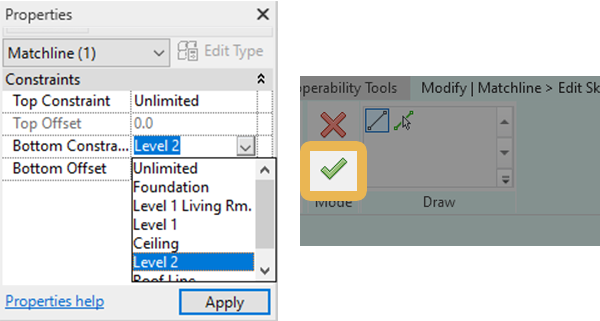
The matchline can be a straight line or a stepped shape. A stepped matchline is useful when the clean split needs to move around rooms, cores, shafts, or annotation-heavy areas. Keep it readable, though. A matchline with too many jogs is harder to follow on construction documents.
For similar annotation concepts, see how to add break line symbols in Revit. A break line shortens or interrupts a drawing object, while a matchline coordinates split views.
Place the Dependent Views on Sheets
Before you judge whether your view reference is working, place the dependent views on sheets. Revit’s view reference tag uses the target view’s detail number and sheet number. If the target view has not been placed on a sheet yet, the reference may show blank values, placeholder dashes, or incomplete numbering depending on the family.
- Create or open the sheets for each split area.
- Drag Area A, Area B, or your dependent views onto their sheets.
- Set the viewport detail number in the Properties palette if your sheet standard requires a specific numbering order.
- Align the crop and annotation areas so the matchline reads consistently across sheets.
How to Add View References to a Matchline
A view reference is the tag that makes the matchline useful. It tells the reader which view and sheet continue on the other side of the split.
- Open the view where you want the reference to appear. If you are on a sheet, right-click the viewport and choose Activate View.
- Go to Annotate tab > Tag panel > View Reference.
- In the contextual ribbon, choose the View Type if you need to filter the target list.
- Set Target View to the dependent view on the other side of the matchline.
- Click beside the matchline to place the reference tag.
- Repeat on the opposite view, pointing back to the first dependent view.

Double-clicking a view reference opens the target view in Revit. After exporting to PDF, the behavior depends on the PDF export method and viewer, but the tag still gives the correct printed sheet reference for construction documentation.
If the default view reference family is missing, load it from your Revit library. In many installations it is named M_View Reference.rfa and is located in an Annotations folder under a path similar to C:\ProgramData\Autodesk\RVT 20XX\Libraries\English\US\Annotations. The exact path can vary by version, language pack, and company deployment.
Learn more about Revit annotation symbols
Edit Matchline Visibility and Line Style
You can control matchline appearance globally with Object Styles, or in selected views with Visibility/Graphics overrides and view templates.
Change Matchlines for the Whole Project
- Go to Manage tab > Settings panel > Object Styles.
- Open the Annotation Objects tab.
- Find the Matchline category.
- Edit the line weight, color, or line pattern.
- Click OK.

Change Matchlines in One View or Template
- Open the view or view template you want to control.
- Go to View tab > Graphics panel > Visibility/Graphics, or press VG.
- Open the Annotation Categories tab.
- Find Matchline and View Reference.
- Turn categories on or off, or apply graphic overrides.
If matchlines keep disappearing, check the view template first. A view template can override the Visibility/Graphics settings in the active view, which makes manual changes appear to fail.
Recommended Office Standard
For clear documentation, use one matchline graphic standard across the project. A medium-to-heavy dashed line is usually readable without overpowering walls, grids, dimensions, and tags. Keep the view reference close to the matchline and place it on the side where the reader should continue.
| Setting | Recommended approach |
|---|---|
| View naming | Use Area A, Area B, East, West, North, South, or grid-based names consistently. |
| Split location | Align with grids, corridors, joints, or simple building breaks. |
| Overlap | Keep a small overlap so readers can recognize the continuation. |
| View reference | Point to the opposite dependent view, not to the current view. |
| Sheet placement | Place target views on sheets before final checking the reference values. |
| Quality control | Preview plotted sheets and check every reference before issuing drawings. |
Fix Common Revit Matchline Problems
Why is my Revit matchline not showing?
Check Visibility/Graphics, the active view template, annotation categories, crop region, and the matchline’s top and bottom constraints. If the matchline was added in the primary view, confirm that you are viewing a related dependent view where it should display.
Why is the view reference blank or showing dashes?
The target view may not be placed on a sheet yet, or the viewport detail number may be missing. Place the target dependent view on a sheet, set its detail number, and then recheck the view reference.
Can I tag a matchline with a normal tag?
No. Use the View Reference tool for matchline references. The view reference family is the symbol that reports the target view’s sheet/detail information.
Why can I not place a view reference on a sheet?
View references are placed in views, not directly on sheet space. If the view is already on a sheet, right-click inside the viewport, choose Activate View, then place the view reference inside the active view.
Can I use matchlines without dependent views?
You can draw annotation lines in many documentation situations, but the intended Revit workflow for coordinated split plans is dependent views plus matchlines plus view references. Independent duplicate views are harder to keep synchronized.
Matchline Setup Checklist
- Create dependent views from the primary view.
- Name the views clearly before placing them on sheets.
- Crop each dependent view with a small overlap at the split.
- Draw the matchline in the primary view.
- Place all dependent views on their sheets.
- Add view references that point to the opposite view.
- Check detail numbers, sheet numbers, visibility, and plotted output.
Final Thoughts
A Revit matchline is simple, but the setup around it matters. Use dependent views when splitting large drawings, draw the matchline from the primary view, place the split views on sheets, and use view references to show the correct continuation. That workflow gives you cleaner sheets, fewer manual labels, and fewer coordination mistakes when drawings change.
For the best result, make matchline graphics part of your office template and include view references in your sheet QA checklist. A good matchline should be easy to see, easy to follow, and automatically tied to the correct sheet information.
References
- Autodesk Revit 2026 Help: Place a View Reference
- Autodesk Revit 2026 Help: Duplicate Views
- Autodesk Revit 2026 Help: Dependent Views
- Autodesk Help: Add a Matchline

Mohamed Fakhry has helped thousands of architects and designers find their next project with step-by-step guidance on his blog, mashyo.com. About Mohamed
His journey began during his university years when he recognized the need for information-rich 3D models to accelerate learning and improve production processes. Now, Mohamed shares his expertise through Revit tutorials that are accessible to all.
